Photogrammetry
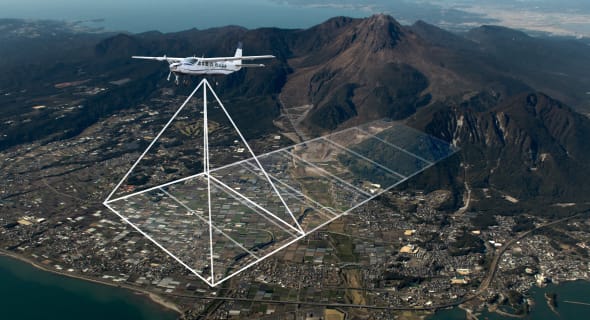
Photogrammetry is the process of reconstructing the 3D geometry of a scene from a series of overlapping photographs taken from different angles. Feature detection algorithms, such as SIFT or ORB, identify distinctive points in each image — corners, edges, or textured patches — and match these same features across multiple overlapping photos. This matching is then used to solve for the camera’s parameters: intrinsic parameters relating to the camera itself, such as focal length and lens distortion, and extrinsic parameters relating to the camera’s position and orientation at the moment each photo was taken, typically refined through a process called bundle adjustment. Once these camera parameters are known, the matched features can be triangulated to calculate their three-dimensional positions, producing a sparse point cloud; additional algorithms then fill in far more points to create a denser point cloud capturing finer surface detail. This dense point cloud can subsequently be converted into a solid mesh with the original photographs applied as texture, resulting in a photorealistic 3D reconstruction of the physical scene.